Saturday, 28 June 2014

Long Term Stock and Bond Return Expectations for Canada - the Current Outlook

A view of probable future returns is essential for individuals to develop realistic planning assumptions for retirement savings growth. Two years ago we wrote about the prospects for long term returns (10 years or more) of the Canadian stock market, the S&P/TSX Composite Index. Our estimate then was an average compound real after-inflation return of 4.2% per year.

The last two years have seen undeniably outstanding stock market growth - almost 32% in price gains alone (leaving aside another yearly 2.5% or so of dividends) as the Yahoo Finance chart below shows. It's time for an update look forward, which we'll also expand by looking at probable bond market returns and inflation.


Stock Returns

Method #1 - First, we'll apply the same method as we did two years ago:

Future Return = Current Dividend Yield + Estimated Growth Rate of Dividends

Current Dividend Yield - The current S&P/TSX Composite dividend yield (the current annualized sum of dividends being paid by the 245 stocks in the index divided by the current stock prices in proportion to the market cap size of the companies) is not easily found. It is not unfortunately not published by the index providers so the individual investor must use an approximation, as Globe columnist John Heinzl described in How to find index yields. The answer is to use the yield on an ETF that tracks the index, such as the iShares S&P/TSX Capped Composite Index ETF (TSX symbol: XIC). Both the Trailing Yield and the Distribution Yield round out to the same 2.4% and the recently lowered MER is now down to a paltry 0.05% so we'll use a Current Dividend Yield of 2.4%.

Estimated Growth Rate of Dividends - A declining working age population and slower population growth in Canada cause forecasters to predict markedly lower economic long term growth rates, as in the chart below from BMO Capital Markets recent publication Long Term Outlook: Destiny Dictated by Demography? (and similarly elsewhere e.g. this report from the OECD where table 4.1 estimates a likely 1.2% per capita GDP annual growth rate)

Taking the OECD figure of 1.2% times the 0.6 proportion that actually flows through to the shareholder (see our previous post and its links as to why all the growth isn't gained by the investor) gives us 1.2% x 0.6 = 0.7% in real future growth rate of dividends.

Thus our total is 2.4% + 0.7% = 3.1% future estimated real long term Canadian stock returns

It is perhaps not surprising that the estimate would be much lower today than two years ago, given the large gains since then, far above the projected average at that time and the long run historic averages.

Method #2 - For comparison, we'll add another method, described in Jay Ritters' paper Economic growth and equity returns, namely the earnings yield, or Earnings / Price.

According to the data for XIC on the iShares website, its P/E is currently 17.6. Turing that upside down gives us E/P, or 1/17.6 = 5.7%. But the ratio should use the past 10-year average of earnings according to Ritter, to smooth out economic booms and busts, not just the current earnings number embodied in the 17.6. Again the data for Canada is hard to to obtain for the individual investor. A rough estimation can be obtained using the TSX earnings figures taken at various points over the last twelve years by InvestorsFriend.com in his evaluation of whether the TSX is fairly valued. The average Earnings since 2005 over the current TSX Price (Index Value) of 15,000 gives an E/P of 4.7%. That number is still too high since the Earnings for each year have not been adjusted downwards for inflation but it gives an upper bound on the probable value.

Another comparison is the projection in the BMO Capital Markets paper, which is 7.0 (before inflation). Taking away 2% for inflation, for example using the figure derived below and which BMO also estimates, that would give a net return of 5.0%. Finally, using yet another method (and higher growth assumptions), InvestorsFriend estimated at the beginning of June based on a lower TSX index value of 14,375, that the TSX Composite would return about 7% annually, which gives the same 5% after inflation.

Our conclusion: over the next ten years, it is reasonable to assume that Canadian stocks are poised to deliver from 3% up to 5% real total return.

Bond Returns
The future return for bonds is simpler to estimate and much more certain. As we have written about previously here and here, bond duration tells us how long we need to stay invested in order to attain, within fairly narrow variation, the yield to maturity of the bond or a bond ETF at the time of purchase. Thus, if we take a bond ETF with long duration of 10 years or more, we know almost exactly what the total return, before inflation, will  be.

Take an average with a third each of the BMO Long Federal Bond Index ETF (TSX: ZFL) with a 14.84 years duration and a yield to maturity of 2.79%, the BMO Long Corporate Bond Index ETF (TSX: ZLC) of 12.85 years duration and 4.34% yield to maturity and BMO Long Provincial Bond Index ETF (TSX: ZPL) of 14.21 duration and 3.69% yield to maturity. That gives a future bond return of 3.6% before inflation, or 1.6% after inflation of 2%.

BMO's estimate for bond returns over the next ten years is 4%, or 2% net of inflation.

Inflation
The best forecast of inflation is the difference between the yield on long term Government of Canada ordinary bonds (2.82% as of June 25) and long term real return bonds (0.78%), which automatically adjust for inflation. These figures from the Bank of Canada webpage with daily updated values for both types show almost exactly a 2.0% (2.82 - 0.78 = 2.04) difference between the two. 2% also happens to be the policy target rate for inflation set by the Bank of Canada. The market rates set by supply and demand obviously believe the Bank of Canada can and will achieve 2% on average. Thus our estimate of 2.0% inflation for the long term.

Wishes, and estimates, don't always come true
It is necessary to keep in mind, as we noted two years ago, that for stock returns, and for inflation, the relationships driving forecasts are not deterministic and there can be considerable variability in actual outcome. It might be a lot more, or a lot less.

A future below historical averages
A 50-50 portfolio of Canadian stocks and bonds would thus produce a blended annual nominal total return of 4.3% to 5.3% and a real return of 2.3% to 3.3%.  That's less than the averages from 1900 to 2013 reported in the Credit Suisse Global Investment Returns Yearbook 2014 for Canada of 5.7% real stock return and 2.1% bond return, or 3.9% in a 50-50 mix. Over a long period that 0.6 to 1.6% gap would make a significant difference. The implication is that investors need to save more to build the same size retirement fund, or take longer to do it and then, in retirement, can withdraw at a lower rate than the 4% rule which worked in the past.

Disclaimer: This post is my opinion only and should not be construed as investment advice. Readers should be aware that the above comparisons are not an investment recommendation. They rest on other sources, whose accuracy is not guaranteed and the article may not interpret such results correctly. Do your homework before making any decisions and consider consulting a professional advisor.

Monday, 23 June 2014

Canadian Preferred Share ETF Comparison - Attractive Income but Some Caveats

Why consider preferred shares?
Preferred shares offer the Canadian investor steady income in the form of tax-advantaged (when held within a taxable non-registered account) eligible dividends. The dividends are usually greater than interest income even before taxes for debt of comparable credit rating and term. With interest rates being so chronically low these days, that can be appealing.

Preferred dividends have claim to company profits after bonds, so there is extra credit risk. On the other hand, compared to common share dividends, preferred dividends have prior claim, though the offsetting downside is that preferred shares do not have the opportunity for capital growth like common shares. Preferred shares stand in the middle between common shares and debt and are generally considered an income investment (see Blackmont Capital's primer on preferred shares, linked to by RetailInvestor.org's preferred share page, which delves into some of the pros and cons in more detail).

Why an ETF?
ETFs devoted to preferred shares offer a convenient way to invest. One purchase can create a permanent low maintenance holding that contains a widely diversified assortment of individual securities, lowering risk of exposure to individual companies. There's no need to rebalance or reinvest when securities are called, no need to figure out which individual securities to buy or sell, it is all done within the ETF by the managers.

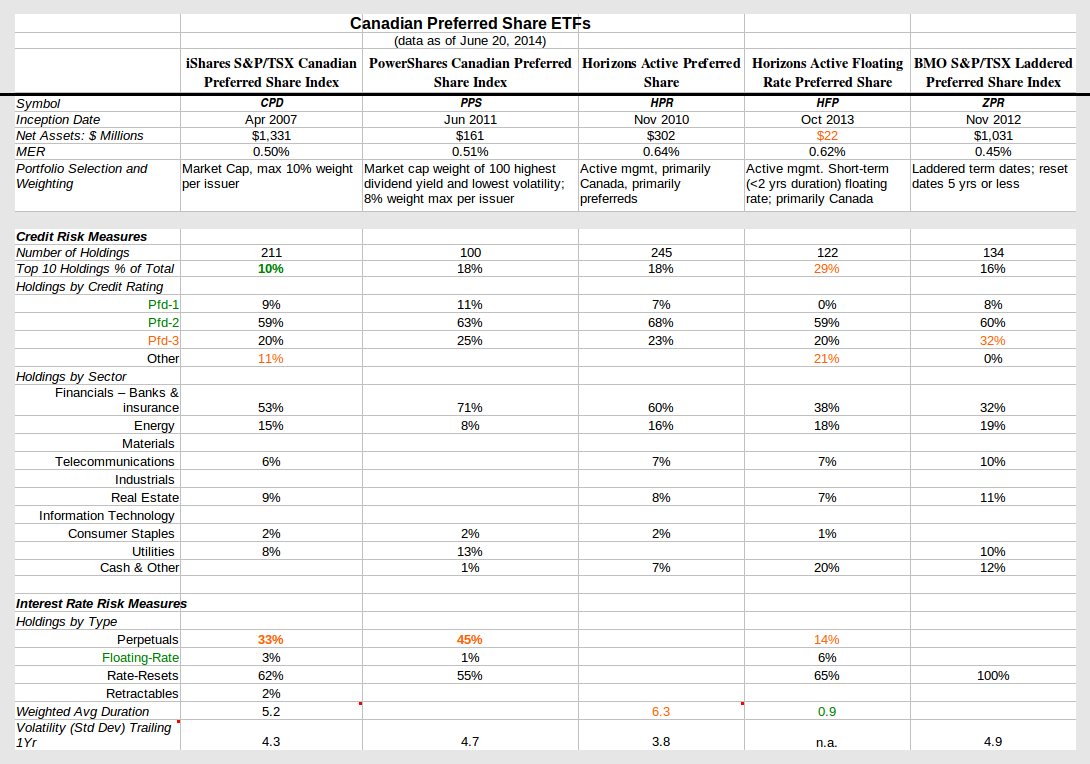
There are currently five ETFs focused on Canadian preferreds. We leave aside US-based offerings since foreign preferred dividends are treated as ordinary income on Canadian taxes and lose their tax advantage. All offer fairly similar expense ratios around 0.5% per year. There are however some fairly marked differences between the funds in their mix of types of preferred share holdings and consequently sensitivity to interest rate changes.

The ETFs
  • Horizons Active Floating Rate Preferred Share ETF (TSX: HFP) - an actively managed ETF where managers apply their judgement, targeting short-term income while keeping value stable despite interest rate change effects; still tiny at $22 million in assets since October 2013 start-up; MER 0.62%
  • iShares S&P/TSX Canadian Preferred Share Index ETF (TSX symbol: CPD) - oldest (2007 inception) and largest in assets at $1.3 billion; strategy is to passively track the overall preferred share market; MER 0.50%
  • BMO S&P/TSX Laddered Preferred Share Index ETF (TSX: ZPR) - second largest fund at $1.0 billion assets, has been catching up quickly to CPD since 2012 inception; invests in a 5-year ladder of preferreds that reset rates. Lowest MER at 0.45%
  • Horizons Active Preferred Share ETF (TSX: HPR) - another actively managed fund "to provide dividend income while preserving capital"; highest MER at 0.64%
  • PowerShares Canadian Preferred Share Index (TSX: PPS) - founded in 2011 but changed its index in May this year to target lower recent volatility and higher dividends whereas before it screened only on liquidity, resulting in a huge shift to a heavy weight in fixed rate perpetual preferreds; MER 0.51%


Diversification and credit risk - trading off sector concentration vs credit rating
As our comparison table above shows, all funds have a substantial chunk (20% or more)  of holdings in in credit rating Pfd-3, which is below investment grade of Pfd-1 or Pfd-2. The fund with the most holdings below investment grade - ZPR at 32% - makes up for it by having a more even spread across sectors and a low concentration in the top 10. Another fund that is highly concentrated in banks and insurance companies - PPS, at 71% - makes up for that by the highest proportion of holdings in the top Pfd-1 credit rating at 11%. HFP has the most concentrated top 10 at 29% but a wide sector spread. There doesn't seem to be any ETF that is clearly superior to the others.

We note also that there has been a significant decline in the overall credit quality of CPD over the last six years as the comparison with statistics by James Hymas in a 2008 Canadian MoneySaver article shows. The proportion of the highest rated Pfd-1 holdings was 65% in October 2008 vs only 9% today. Many major bank issues got cut from Pfd-1 to Pfd-2. Pfd-3 holdings have also risen substantially. Many new issuers offering preferred shares, such as industrial companies, are below investment grade. Lower credit quality raises credit / default risk.

Interest rate risk exposure - the biggest differentiator
Four funds appear to be most exposed to changes in interest rates - CPD, PPS, ZPR and HPR - though it is hard to tell which is most exposed. The weighted average duration (which is a measure of sensitivity to interest rate change, the higher the number the greater the sensitivity) of their holdings at 5.2  for CPD and 6.3 for HPR are one indication. In comparison, the broad benchmark bond ETF from iShares (TSX:XBB) has a duration of 7.09 while a short-term bond fund - iShares' XSB -  has a duration of 2.87. Though Invesco does not provide a duration figure for PPS, we estimate that it will have a similar interest sensitivity by virtue of its large 45% component in perpetuals, which are by far the most sensitive type, as seen in the following chart from Scotia McLeod's Guide to Preferred Shares.

Horizons' HFP is the least sensitive to interest rates, with a duration of only 0.9, a reflection its policy to keep holdings in short-term resets and floating rate preferreds. BMO's ZPR theoretically should fit in between HFP and the others, with its strategy of holding preferreds that will reset rates in five or less years. But the price action of the various ETFs seen in the chart below contrasting ZLB vs the other preferred ETFs and XBB suggests that it behaves much like CPD. And HPR has been less volatile than CPD and ZPR - it looks as though the active management strategy of HPR "to preserve capital" has been effective.

Despite the higher duration of XBB, CPD and ZPR dropped more in 2013 when interest rates took their upward spike.

Attractive payouts and reasonable but volatile returns
An important lesson for investors is that preferred share ETFs can be quite volatile compared to bonds. In 2008-2009 during the credit crisis and the recovery, CPD took a big drop in 2008 with a 17.2% negative return and in 2009 with a 26.2% positive return while XBB toddled along smoothly at +6.1% and +5.0% respectively.

Our second comparison table below shows recent cash payout rates. Four of the ETFs are paying out 4.1 to 4.9% depending on which payout measure is used, while HFP is paying 2.1 (trailing 12 months) or 3.4% (current yield). That's attractive income compared to XBB's 3.2% distribution yield and 2.4% yield to maturity, especially when tax rates are taken into account (it can take $1.30 of pre-tax interest to equal the net after-tax of $1 of dividends in a taxable account, though this varies depending on the investor's tax bracket and province) and the fact that a good chunk of the preferred ETF payouts has been non-taxed Return of Capital.


However, not all is sweetness and light. Returns - which includes both dividends and capital gains/losses - have not been nearly so attractive in the short term. Three of the four (CPD, ZPR and PPS) that have been around long enough (at least a full year) to officially report returns show negative 1-year returns. The 2013 interest rate rise hurt capital values. In addition, the capital losses seen in the above price chart have caused the ETFs to have bad Return of Capital, merely giving investors their own money back. As a recent Raymond James Canadian Preferred Shares Report points out (see pages 2-3) many of the Reset preferreds are being and will be called in 2014 by the issuers and new issues will have lower dividend rates. The reality of the low interest rate environment is being absorbed and cash payouts have been falling.

It is very hard to predict exactly how an investment in these preferred ETFs will fare. There is such a mix of inter-acting factors that can affect eventual returns and future income / cash payouts - interest rates, most obviously, but also credit risk, call risk (likelihood of issues being redeemed prematurely, when it advantages the issuing company and not the investor), the required return differential between government debt and corporate preferreds, the variable mix of types of holdings within each ETF and the wide variety of special redemption or retraction features attached to the types of preferred shares. Finally, and ironically, to some extent the tail is wagging the dog - flows into or out of the ETFs themselves are so large that they affect the market for underlying preferred shares according to Scotia McLeod's annual Guide to Preferred Shares 2014 edition. Unlike bond index funds whose future possibilities under rising interest rates we examined last year, we would hesitate to forecast the probable evolution of any of these ETFs in detail. Certainly, if interest rates rise, the capital value / market price of the ETFs will fall in response, but by how much and for how long is too hard to tell.

Bottom line - Though it is not possible to predict exactly what will happen, the ETFs would slot into a fixed income portion of a portfolio as follows:

  • Horizons' HFP fits as a reasonably stable short-term holding that generates better after-tax income than a short-term bond fund
  • The others are best considered for longer term or indefinite time holdings to generate fairly steady income superior in varying degrees over the years to bond funds but with volatility in capital value.


Disclaimer: This post is my opinion only and should not be construed as investment advice. Readers should be aware that the above comparisons are not an investment recommendation. They rest on other sources, whose accuracy is not guaranteed and the article may not interpret such results correctly. Do your homework before making any decisions and consider consulting a professional advisor.
Monday, 16 June 2014

Centenarian Companies in Canada - Surviving and Thriving, Mostly

We'd all like to live to be 100 years old. But more than that, we'd like to be healthy and vigorous. It's not easy to achieve for people and just as difficult for companies. We decided to have a look at Canadian publicly traded companies that have existed for at least a century to see how they are doing, whether they are merely surviving or doing well.

No casualties amongst 2010 centenarians - The first pleasing thing to note is that all twelve of the companies in our 2010 post Twelve Ultimate Buy and Hold Canadian Stocks are still around and doing quite well, thank you.

Dominant players on the TSX - Three of the centenarians, led by the Royal Bank (TSX: RY), followed by TD Bank (TSX: TD) and Scotiabank (TSX: BNS), are the three largest companies, measured by total market value of stock, in Canada.

Beyond the original twelve, we did more digging (in University of Western Ontario's Canadian Centennial Companies and the Globe's Report on Business Top 1000) and uncovered another dozen companies that have a continuous 100-year history, though at times quite eventful (we are thinking especially of the oldest one of all, the Hudson Bay Company, which went private for several years recently and has undergone plenty of restructuring).
(click on table to enlarge image)


The two dozen companies together are massive - they constitute only 10% of the number of companies but they make up 33% of the total value of the TSX Composite Index. As our comparison table shows, the centenarians' market cap almost all far exceed the average of $1.6 billion (based on the stats from the iShares ETF (TSX: XIC) that invests in the TSX Composite).

Banks and insurance companies in the majority - Almost half (11) of the companies are financial companies, including all of Canada's largest banks. There is only one or two representatives from other sectors - mining (Teck), forestry (Domtar, though it evolved from an industrial company), industrials (CPR and Russel Metals), energy (Imperial Oil and Enbridge, which was originally Consumers Gas), booze (Corby and Molson), telecommunications (BCE), consumer (HBC, North West Company and George Weston) and publishing (McGraw-Hill Ryerson).

Stock price stability - The majority of the centenarians' stock prices are quite stable, as the Beta (a measure of a stock's price volatility compared to the market average) figures below the market average of 1.0  in our table demonstrate. Of course, when the stock market experiences extreme stress, as during the 2008 financial crisis, then the stock price stability can change dramatically. The nature of the crisis will influence individual stock reactions too - during the financial crisis, bank stocks in Canada, despite the strength of Canada's banks unlike those of the USA, Europe and the UK, suffered a sharper drop than the overall TSX. The bank stocks' price recovery was faster than the TSX too, pushing up the Beta, as the chart from TMX Money below shows. Upward high volatility / Beta can be good - current CPR shareholders will attest to that.


Prosperous and healthy at the moment - The centenarian companies are still as blue chip as they come (cf  Earnings, Dividends and Return on Equity in our comparison table above) with solid consistent profits, healthy and rising dividends. Only HBC is losing money and only Manulife has a negative stock return over the past five years and only three companies have 5-year compound returns less than the TSX Composite/XIC.

All the companies pay dividends but the growth of dividends is one relatively weaker spot of the centenarians. One company - MFC - has had to cut dividends. Several others have not increased theirs at all over the past five years while others have not increased their distributions by as much as XIC's 6.4% annual rate.

One other apparent anomaly on dividends, North West Company's (TSX symbol: NWC) 2% drop in dividends is a result of its conversion from income trust to corporation in 2012, which forced it to change from distributing pre-tax income to after-tax dividends (and which would leave an investment in a taxable account no worse off due to the dividend tax credit). The corporate NWC has increased its dividend in 2013 and again in 2014, up a total of 17% over 2012.

Swings and roundabouts of company and shareholder returns - Extending the view of these companies' histories shows that some have done considerably better than others.

The chart below using BMO InvestorLine's graphing tools shows the price-only (i.e. excluding dividends) performance since 1984 of four of the centenarians - Royal Bank, BMO, Russel and Imperial Oil - against the TSX. The dark blue line of RY is way above the others, though at one point in 2007, IMO briefly topped it. Meanwhile Russel has doddered along, more or less returning nothing but dividends to shareholders who may have bought 30 years ago.

That doesn't look at all good for Russel ... but then consider the last ten years alone. Suddenly, Russel is the best performer of all, exceeding even Royal Bank. Stay in the game long enough and good things may happen. We might adapt the Star Trek motto, "Live long and prosper" to "Live long enough and you will prosper".

The mix of positive and negative analyst recommendations in our table suggests however that success is not assured. Indeed our list of centenarians is biased in that it includes only survivors and excludes those many companies that have fallen by the wayside.

Yogi Berra's delightful quote, "it ain't over till it's over", sums it up. Unlike people, whose bodies and minds eventually deteriorate but cannot be repaired or replaced, companies have the potential to bring in new people, hopefully to absorb and continue the best elements of the past while adapting to inevitable changes. A report in the Economist magazine suggests that longevity and prosperity are not accidentally associated. The centenarians provide an interesting starting list of companies to consider for a long term portfolio.

Disclaimer: this post is my opinion only and should not be construed as investment advice. Readers should be aware that the above comparisons are not an investment recommendation. They rest on other sources, whose accuracy is not guaranteed and the article may not interpret such results correctly. Do your homework before making any decisions and consider consulting a professional advisor.

Friday, 30 May 2014

A Lifelong Portfolio and Investing Plan for the Reluctant Investor - Aims and Plausible but Inadequate Options

"Everything should be made as simple as possible, but not simpler." Albert Einstein
Some people enjoy investing, but many do not, looking upon it as a necessary evil that is daunting for its complexity and potential danger. Even the slimmed down list of essential topics for the self-directed investor we presented in our last post may be too much for many, whether due to time or interest. Are those people to be forced to avoid self-directed investing altogether?

Today we take up Einstein's challenge for the Canadian self-directed reluctant investor, the person who just wants to be told told what to do in the least amount of time in the least technical manner possible but who insists on something that is effective. First, let's be more specific in defining what the portfolio should do.

Objectives of the Portfolio
We set the following demanding objectives for our portfolio. Our solution is necessarily a compromise to some degree as there are trade-offs amongst several objectives.
  • Suitable for all ages and phases of life from savings through to withdrawal in retirement - the same securities, which will be Exchange Traded Funds (ETFs), in the same proportions, forever; the portfolio never needs to change
  • Suitable for any type of account - RESP, RRSP (and all the other registered retirement account variations like RRIF, LIRA, LIF), TFSA or even taxable
  • Suitable for any investment time horizon - the portfolio should be good enough to do an ok job whether it will be cashed in a tomorrow or in 40 years. Thus, we try to remove the planning headache of figuring out when we will need the money and trying to adapt the portfolio's holdings to match. Can we really be sure anyway when we will want or need the money? Things change and life is full of surprises. We want a portfolio that copes well with uncertainty. 
  • As automatic as possible in every way, from contributions, to investment, to on-going management like re-investment of interest or dividends received, to withdrawal
  • As low cost as possible - the lower the fees incurred, the more stays in the investor's pocket
  • As tax effective and simple as possible - investments should be put in tax-advantaged accounts like TFSA and RRSP where no tax reporting is required and, when those are filled to maximum contribution limits, in a regular taxable account. Should tax reporting be required, we want that process to be as straightforward as possible too. Einstein had it right on this point too, when he said, "The hardest thing in the world to understand is the income tax." This is one area where we could not eliminate complexity entirely. The problem is with taxable accounts and the calculation of capital gains, where the investor must keep track of Adjusted Cost Base. 
  • Incorporating diversification to limit volatility at all times and to benefit from the longer term re-balancing boost to returns
  • Avoid the potential complexities of dealing with foreign exchange, while gaining the return and diversification benefit of foreign investments. The foreign investment objective is the biggest compromise of our Reluctant Investor Portfolio, as our proposal is Canadian investments only. 
  • Minimize mental stress and danger of panic reaction of selling at the wrong time (e.g. late 2008 after the stock market plunge in the financial crisis) by limiting volatility. At the same time, the portfolio is very orthodox mainstream, so that the investor can feel comforted doing what the average of everyone does, reducing the risk of regret. 
Testing the Portfolio through Historical Performance - To see what kind of performance the Reluctant Investor Portfolio would have provided, we will turn to the Stingy Investor Asset Mixer tool.

Alternatives, with the Trade-offs that led to rejection
Before we reveal the portfolio and investing plan that we believe best fits the objectives, let's look at some options that don't quite work in our view.

1) iShares Balanced Income CorePortfolio™ Fund (TSX symbol: CBD) - That's right, a single fund, only one thing ever to buy or sell. This ETF is a serious contender that might still appeal to some.

Pros
  • Maximum convenience and simplicity: a single ETF that avoids any need for the investor to do rebalancing, it is all done automatically within the ETF by the iShares managers; this ETF is part of iShares' free DRIP, PACC and SWP plans meaning you can set up instructions for regular contributions or withdrawals; no worries of questions about which ETF goes into which account; only one ETF for which to keep track of Adjusted Cost Base for eventual capital gains reporting if held in a taxable account
  • Well diversified with many types of stock and bond holdings, including foreign holdings; in this aspect it is better than the Reluctant Investor portfolio
Cons
  • Annual fees at 0.72% is starting to be a bit high, eating into net returns
  • Volatility is higher despite the variety of holdings - in its short history from 2007 startup, it declined about 25% by early March 2009. Though it has recovered strongly since, that might be too un-nerving for some to stick with it. Plus the effect of withdrawals at that point when in retirement mode, would seriously harm the portfolio.
2) All Bonds, whether a broad Total Market mix or Short-term Bonds

Pros
  • Convenience and simplicity, due again to holding only a single fund
  • A bit less volatility - there were fewer down years than for our winning choice according to Stingy Investor, though the difference is slim and not always favorable when it included annual retirement withdrawals of 4%
Cons
  • Lower returns and much less total accumulation during savings mode per more historical calculations and very slim returns in retirement withdrawal mode. The clincher for us looking forward is that we know bond returns since 1980 have been greatly boosted by falling interest rates. That trend has stopped now at the bottom so betting all on bonds cannot produce the same juicy returns. That's an important principle of our winning portfolio - it hedges the uncertainty of whether stocks or bonds will do better.
  • No tax efficiency if held in a taxable account - interest income is taxed at the highest marginal rate
3) GICs only

Pros
  • Simplicity - everyone knows and understands how they work
  • Stability - their price never varies (though there is an implicit but not visible change in value when interest rates change) and the price paid back is known in advance
Cons
  • Convenience - Minimum purchase amounts start at $500, but how is an investor to manage purchases on a regular basis. Avoiding having a multiplicity of small GICs that will require constant effort to track and reinvest as they mature, as well as time to look up the best rate, which changes constantly from the different financial institutions. Automatic reinvestment with the same financial institution won't get the best rate. Getting the best rate also means tieing up money in non-cashable GICs, which makes it impossible to get all, or even most, of your money fast if you suddenly want to make a big purchase, especially if one implements the oft-suggested 5-year ladder of GICs.
  • Returns are lower over the long term, as this historical table from London Life of GICs against TSX stocks and other investments shows
  • No tax efficiency if held in a taxable account - interest income is taxed at the highest marginal rate
Nest week, we will reveal what we believe is the winning formula for Einstein's challenge - the portfolio and the investing plan to go with it.

Disclaimer: This post is my opinion only and should not be construed as investment advice. Readers should be aware that the above comparisons are not an investment recommendation. They rest on other sources, whose accuracy is not guaranteed and the article may not interpret such results correctly. Do your homework before making any decisions and consider consulting a professional advisor.

Friday, 23 May 2014

HowToInvestOnline Guide to Self-Directed Investing

Over the years, we believe that many of the posts we have published have enduring value, as statistics on accumulating reader visits on old posts demonstrate. But there are so many posts that to help readers find their way around, we have now selected, organized and categorized posts into the key investing topics. We've ignored some of our posts, topical at the time, which have become outdated.


Investing 101 - posts in green: the investing basics, which we believe every self-directed investor should know to successfully build and manage a portfolio.
  1. Why Be a DIY Investor and What Does It Take to Succeed?

1) Setting Objectives

  1. A Process to Build a Sound Investing Plan
  2. Setting Investment Objectives
  3. Reviewing Your Financial Assets
  4. Investment Building Blocks - Securities
  5. Investing Principles - Minding the Immutable Forces
  6. A Written Investment Policy, Don't Invest a Cent Without It
  7. Investing for Children: Getting the Goal and Timing Right for Education

2) Getting the Thinking & Decision-Making Right

  1. Psychology of Stock Market Investing: Patience
  2. Five Common Investor Judgment Errors and How to Counter Them
  3. How to Fix Overconfidence, the Worst Investing Attitude Problem
  4. Exploiting Laziness, Procrastination and Conformity in Investing
  5. Controlling Your Own Investing Over-Confidence
  6. Coping with an Uncertain Investment Time Horizon

3) Setting Expectations Grounded in Reality

  1. Investing Lessons from a Golf Game
  2. How to Spot and Avoid Investing Scams
  3. Is Putting Money into the Stock Market Just Gambling?
  4. What Long Term Return Can We Expect from the TSX?
  5. Long Term Stock and Bond Return Expectations for Canada - the Current Outlook (June 2014)
  6. Long Term Return Expectations for USA and Rest of World - the Current Outlook (June 2014)
  7. The TSX and How Blue Chip Stocks Have Done: Food for Thought
  8. TSX Composite and S&P 500 Total Market Return
  9. Investing History Lessons on Inflation Protection and Market Mood Swings
  10. Test Your Portfolio with Historical Investing Returns
  11. Gulp! Asset Allocation & Rebalancing Theory Meet a Scary Real World
  12. The 2008 Crash - Case Study in Diversification
  13. Deflation, Inflation - Which is coming and What to do?
  14. Investing During Deflation
  15. The Historical Effect of Inflation and Currency on a Canadian Investor's International Portfolio

4) Risk

  1. Investing Big Stuff vs Small Stuff
  2. Risk: What Can You Afford and What Can You Put Up With?
  3. Protection for the Online Investor Against Insolvencies and Defaults
  4. Risk Tolerance: Why and how to measure your own
  5. Risk Capacity: What is your capacity and does it match your tolerance?
  6. Risk Need - Figuring out how much risk you need to take
  7. Investing Risk: What is there to lose?
  8. Investing Risk: Historical Worst Volatility, Business Cycles, Crashes and Crises
  9. Investing in a Recession and Avoiding Depression
  10. Investing Risk: How Badly did Inflation and Currency Hurt Past Returns?
  11. Investments to Protect against Inflation
  12. Deflation, Inflation - Which is coming and What to do?
  13. Investing Risk: Default or, How often do investments go belly up?
  14. Seeking Safety: Assessing Default Risk
  15. Investing Risk: The Ouch from Management Costs and Taxes
  16. Investing Risk: The Harmful Effect of Rising Required Rate of Return
  17. What are the important long term investing risks? (Volatility is NOT one of them)
  18. Are Stocks less, or more, risky in the long run?
  19. ETF Risks - Which Matter, Which Don't, What to Do

5) RRSP, TFSA, RESP, In-Trust vs Taxable Accounts

  1. RRSP vs TFSA vs RESP vs Non-Registered Taxable Account?
  2. RRSP vs TFSA? First, the Numbers
  3. RRSP vs TFSA? Critical Differences and Imponderables
  4. Cash in a TFSA or RRSP - What are the best choices?
  5. Save Tax by Income Splitting with RRSP, TFSA, Loans and Pension Income
  6. Investing for Children: RESP or In-Trust For Account?

6) Asset Allocation and Portfolio Construction

  1. Asset Allocation: the Most Important Investing Decision You Will Make
  2. How to Diversify without "Diworsifying"
  3. How Many Stocks to Create a Diversified Portfolio, or Should You Even Try?
  4. Five Reasons to Go Beyond the One-Stop-Shopping Portfolio
  5. Portfolio Rebalancing - What, Why and How
  6. Dollar Cost Averaging - the Good Truth and the Bad Myth
  7. Investing Implications of a Globalized World
  8. Investing Ideas from Norway, Home of a Humongous Pension Fund
  9. Surprise! Equities can Outdo Bonds for Cash Distribution Attractiveness
  10. The Crucial Difference between Price and Income Stability of Equities
  11. Investing for Children: Building a Portfolio from Scratch with Regular Small Savings
  12. Foreign Investments: To Hedge or Not to Hedge Currency
  13. Foreign Investments: What does history tell us about hedging currency?
  14. Hedging Foreign Currency Exposure - Is it worth it? CalPERS Changes Tack and ETF Case Studies
  15. A Falling Canadian Dollar Can be An Investor's Friend
  16. Building Your Own Index ETF
  17. Low Volatility Equity ETFs - Promising Safety and Reward
  18. Low Volatility ETF Update - Are they performing as advertized?
  19. Portfolio Volatility of Swensen Seven, Smart Beta vs Simple Recipe - Which is best?
  20. How to Minimize Portfolio Volatility and Sleep (a lot) Better
  21. Investing Ideas from Two Highly Successful Pension Funds - Ontario Teachers' and Healthcare of Ontario
  22. Mortgage/Debt-Adjusted Asset Allocation
  23. Tax-Adjusted Asset Allocation
  24. How to Assess Your Annual Portfolio Performance
  25. Using Indices to Benchmark Your Investment Results
  26. The Annual Investment Review: Part 1 - Review Goals & Performance, Rebalance
  27. The Annual Investment Review: Part 2 - Tax Matters

7) Model Portfolios

  1. One-Stop-Investing for Your RRSP Contribution(s)
  2. Five Reasons to Go Beyond the One-Stop-Shopping Portfolio
  3. A Lifelong Portfolio and Investing Plan for the Reluctant Investor - Aims and Plausible but Inadequate Options
  4. The Reluctant Investor's Lifelong Portfolio - a Portfolio Inspired by, and for, Albert Einstein
  5. Simple Portfolios Compared
  6. New Improved Model Portfolio: The Smart Beta
  7. A Model Pre-Retirement Portfolio for Canadians - The Swensen Seven
  8. Portfolio Volatility of Swensen Seven, Smart Beta vs Simple Recipe - Which is best?
  9. The Permanent Portfolio: Pros and Cons for Canadian Savers and Retirees
  10. Inside the Permanent Portfolio - Why it succeeded and the chances it will continue
  11. Currency and Inflation Effects on Model Portfolio Performance

8) Portfolio Components – the Actual Securities to Buy and Sell

a)ETFs

  1. ETF Screeners Compared
  2. A Compendium of ETF Resources
  3. ETF Risks - Which Matter, Which Don't, What to Do
  4. ETF Liquidity Risk - What's real, What's hype, What to do
  5. Canadian Large Cap Equity Index ETFs Update - Surprises for Investors
  6. Return of Capital: Separating the Good from the Bad
  7. Canadian ETFs with High After-Tax Cash Yields - Separating the Good from the Not so Good
  8. How does RBC's new Canadian Dividend ETF compare?
  9. The #1 Canadian Dividend ETF according to the Shareholder Yield Test
  10. ETF Comparison: USA S&P 500 or Similar Equity Index Funds
  11. ETF Comparison: Developed Country Diversified Equities
  12. Emerging Markets ETFs Comparison Update - Which is best?
  13. Surprise! Equities can Outdo Bonds for Cash Distribution Attractiveness
  14. Canadian Equity Low Volatility vs Cap-Weight ETFs Reviewed
  15. Choosing Between US and International Equity Low Volatility vs Cap-Weight ETFs
  16. Best Pick Commodity ETFs/ETNs for the Canadian Long Term Investor
  17. Commodity ETFs - Ins and Outs for Canadians
  18. Investing in Utilities - Individual Stocks vs Funds
  19. Socially Responsible Investing: Trends and ETF Track Records
  20. Vanguard Index Change and Navigating The ETF Maze for Global Equities
  21. Pros and Cons of Cross-Border Shopping in the USA for ETFs
  22. Cross-Border ETFs - Here's a Free Tool to Compare Costs
  23. S&P 500 Currency Hedged ETFs - How Well do They Work and Which is the Best?
  24. Different and Better(?) Ways to Invest in the Broad US Equity Market
  25. New iShares Preferred Share ETF - How Does It Compare?
  26. Pros and Cons of Managed Futures ETFs
  27. Canadian Real Estate ETFs - Which is best?
  28. Building Your Own Index ETF
  29. How to Sharpe-n Your ETF Selection Process
  30. ETFs and Mutual Funds - Calculating Capital Gains

b) Canadian Stocks

  1. What Long Term Return Can We Expect from the TSX?
  2. Long Term Stock and Bond Return Expectations for Canada - the Current Outlook (June 2014)
  3. Canadian Aerospace, Waste Management and Engineering Companies - Sustainability, Social, Environmental and Governance Ratings
  4. Canadian Transportation Companies - Sustainability, Social, Environmental and Governance Ratings
  5. Canadian Mining Companies - How do they rate on Sustainability, Environmental, Social and Governance issues?
  6. Canadian Oil & Gas Stocks - Does better Corporate Sustainability & ESG mean better performance?
  7. Corporate Sustainability (aka SRI/ESG) in Canadian Consumer Stocks
  8. Twelve Ultimate Buy and Hold Canadian Stocks
  9. Which Stocks and ETFs are Safe and Secure per the Dispersion of Analyst EPS Estimates (Nov 2014)
  10. Centenarian Companies in Canada - Surviving and Thriving, Mostly
  11. Dogs of the Dow and the TSX - Are they nasty or nice investing pets?
  12. Bank Stocks: Alternative Ways to Invest
  13. Electric Power Utility Stocks for the Income Investor?
  14. Entertainment Companies: Potential Investment Thrills or Spills?
  15. Investing in Utilities - Individual Stocks vs Funds
  16. Dual Class Shares - Are they Ok or to be Avoided?
  17. Dividend Stock Olympics - The 15 Canadian Medalists (Feb 2014)
  18. Canadian Equity Market Darlings and Dogs: August 2014 Update
  19. Canadian CEO Pay Update: Who earned their pay by rewarding investors?
  20. Top-100 Canadian CEOs Update: Who is the Most Over-Paid?
  21. The TSX Composite - Which are the real blue chips? (Sep 2013)
  22. Update on High-Yielding Canadian Mortgage Companies: New Entrants & Rising Interest Rate Effects (Aug 2013)
  23. Dividend ETFs and Stocks - Attractive Cash Distributions and Returns
  24. Going on Autopilot with Dividend Reinvestment
  25. Shareholder Yield - the New, Improved version of Dividend Investing
  26. Shareholder Yield - How do the popular dividend stocks measure up? (August 2014)
  27. Investing in Illiquidity - Where the small guy has an advantage
  28. Using the "Wisdom of Crowds" of Analysts to Find Safe, Profitable Canadian Stocks

c) Preferred Shares, Split Shares and Closed-End Funds

  1. Preferred Shares: an Opportunity for Taxable Accounts
  2. Dividend Income from High Quality Preferreds: Split Shares, Companies and ETFs Compared
  3. Split Share Preferreds - Opportunity from an Outlier?
  4. Split-Share Corporations - Christmas Bargains Amongst Capital Shares?
  5. New iShares Preferred Share ETF - How Does It Compare?
  6. Closed-End Funds - Opportunity vs Risk

d) Real Estate Investment Trusts (REITs)

  1. Real Estate Investment Trusts for Income and Diversification
  2. Return of Capital: Separating the Good from the Bad
  3. Green Certification of Real Estate - Why investors should care
  4. What's up, or should we say down, with REITs?
  5. Canadian Real Estate ETFs - Which is best?
  6. Ins and Outs of Managing Your Own Portfolio of REITs

e) Preferred Shares

  1. Preferred Shares with High-Yield, Safety and Fixed Maturity

f) Convertible Debentures

  1. Convertible Debentures: the Certs mint of investments

g) Fixed Income – Cash, Bonds, GICs

  1. Cash in a TFSA or RRSP - What are the best choices?
  2. Tools and Tips for Picking the Highest Rate GIC
  3. Fixed Income: Which is "best" - GIC, Individual Bonds, Target Maturity ETF or Traditional ETF?
  4. Tax-efficient Fixed Income for Non-registered Taxable Accounts
  5. Bond Ladder vs a Bond Fund? Part1: Ladder Pluses
  6. Bond Ladder vs Bond Fund? Part 2 - Fund Pluses
  7. Which Way is Best to Invest in Real Return Bonds - Direct, ETF or Mutual Fund?
  8. Green Bonds - The Fixed Income Way to Invest by ESG/SRI Principles
  9. Fixed Income - the best rates in Canada across the maturity spectrum (September 2014)
  10. What Happens to a Bond ETF When Interest Rates Rise?
  11. Which Bond ETFs are Most Vulnerable to a Rise in Interest Rates?
  12. Surprise! Equities can Outdo Bonds for Cash Distribution Attractiveness
  13. Ways to Get Steady Dependable Income from Mortgages
  14. High Yield Bonds - Take a Chance on Them?
  15. Ins and Outs of International Bonds

h) Commodities

  1. Commodities: Diversifier and Inflation Hedge or Empty Promise?
  2. Best Pick Commodity ETFs/ETNs for the Canadian Long Term Investor
  3. Commodity ETFs - Ins and Outs for Canadians
  4. Gold: the Why, What and How of Investing in It
  5. Gold Bullion Investing Online: How the alternatives compare

i) Alternative & Fringe Assets

  1. Holiday cheer alternative - Investing in wine and whisky

9) Taxes

  1. Taxes 2015: Compendium of Links & Resources for Filing 2014 Income Tax
  2. Five Last Minute Tax Reducers for Investors
  3. How Your Province, Income Level and Investment Choices Affect Your Income Tax
  4. How to Calculate Capital Gains and Other Income Taxes on ETFs
  5. ETFs and Mutual Funds - Calculating Capital Gains
  6. How to Calculate Interest and Capital Gains for Tax on Bonds, T-Bills, GICs, CSBs
  7. The Mystery of Fund Capital Gains in 2008 Explained
  8. Light at the end of the ACB Tracking Tunnel for ETFs?
  9. Taxes on Foreign Investments
  10. Foreign Income & Assets - Avoid Nasty T1135 Trouble
  11. How to Avoid the Misery of T1135 Foreign Holdings Disclosure
  12. Save Tax by Income Splitting with RRSP, TFSA, Loans and Pension Income
  13. Five Tax Tips for Investor Couples and Families
  14. Tax-efficient Fixed Income for Non-registered Taxable Accounts
  15. Tax Planning for Investors in or near Retirement: Age Credits and OAS Clawbacks
  16. Saving Taxes on Investments at Death
  17. Tax Loss Selling Explained: What, Why and How
  18. Tax-Adjusted Asset Allocation
  19. Income Tax on Dividends: How to Cope with the Myths and the Realities

10) Retirement

  1. Three Key Investing Principles for Retirees
  2. Lessons for Investors from Warren Buffett's Illness (Apr 2012)
  3. What is a Viable Mix for Retirement Savings Success?
  4. Adjusting RRIFs and RRSPs to the New Reality
  5. How to Invest for Retirement Like a Pension Fund by Using ETFs
  6. Two Ways of Generating Cash from a Portfolio
  7. Generating Cash: Income from Securities with the High-Yield Couch Portfolio
  8. Generating Cash: Asset Allocation with the Global Couch Potato Portfolio
  9. A Sustainable Portfolio Withdrawal Rate: the 4% Solution
  10. Refining the 4% Retirement Withdrawal Rate Rule: Pay Attention to Stock Market Valuation (Sept 2014)
  11. Testing the Ultra-Safe ARVA Retirement Portfolio Withdrawal Method
  12. Liability-Driven Investing during Retirement for the Individual
  13. Retirement Spending Rules and Forced RRIF Withdrawals
  14. Why Retirees Need to be More Concerned about Portfolio Volatility
  15. The Retired Investor - Real Return Bonds for Essential Living Expenses
  16. Tax Planning for Investors in or near Retirement: Age Credits and OAS Clawbacks
  17.  Saving Taxes on Investments at Death
  18. Retirement Investing - How an Annuity Complements an Equity-Fixed Income Portfolio

11) Sustainable Investing – Incorporating Environmental, Social & Governance Factors

  1. Socially Responsible Investing - Putting Your Money Where Your Morals Are
  2. Green Investing - Doing Right and Doing it Right
  3. Socially Responsible Investing: Trends and ETF Track Records
  4. Socially Responsible (Environmental, Social, Governance) Investing - What difference does it make?
  5. Stocks & Board Governance - Do the Good Guys Finish First or Last?
  6. Women on Boards of Directors in Canada - Should Investors Care?
  7. Women on Boards: Pleasing Progress (Nov 2014)
  8. CleanTech & Profitable Investment - Yes, the Two Can Go Together
  9. Socially Responsible Canadian Large-Cap Companies - Who's the fairest of them all? (August 2014)
  10. Canadian Aerospace, Waste Management and Engineering Companies - Sustainability, Social, Environmental and Governance Ratings
  11. Canadian Transportation Companies - Sustainability, Social, Environmental and Governance Ratings
  12. Canadian Mining Companies - How do they rate on Sustainability, Environmental, Social and Governance issues?
  13. Canadian Oil & Gas Stocks - Does better Corporate Sustainability & ESG mean better performance?
  14. Corporate Sustainability (aka SRI/ESG) in Canadian Consumer Stocks

12) Tactical Investing – Looking for Market Bargains

  1. IPOs: Avoiding the Dangers and Spotting the Opportunities
  2. Twelve Tricks in Financial Statements and How to Detect Them
  3. Financial Statement Manipulation and Fraud: A Dirty Dozen Warning Signs
  4. Insider Trading: Using It to Get an Edge, Legally of Course
  5. Getting Started in Value Investing
  6. Taking Advantage of Value Stocks
  7. "Small is Beautiful" - Also True for Investing
  8. P/E and PEG Ratios - Remember the Effect of Interest Rates
  9. Stock Market Analyst Forecasts: add Salt and Pepper
  10. Stocks & Board Governance - Do the Good Guys Finish First or Last?
  11. Investment Climate Change: The Mysterious Case of Hot January Returns
  12. Using Weak Currencies to Find Foreign Equity Investment Opportunity (Jan 2013)
  13. Picking Countries with a Weak Currency - How did it perform? (Mar 2014)
  14. Using the "Wisdom of Crowds" of Analysts to Find Safe, Profitable Canadian Stocks (Dec 2012)
  15. How Effective is Using Dispersion of Analyst EPS Estimates to Assess Stocks? (Nov 2014)
  16. Which Stocks and ETFs are Safe and Secure per the Dispersion of Analyst EPS Estimates (Nov 2014)
  17. Which Large Cap TSX Stocks are Most Dangerous or Most Attractive? - Use Short Interest with Volatility
  18. Shareholder Yield - the New, Improved version of Dividend Investing
  19. Dividend Initiators as a Stock Selection Concept
  20. Share Repurchases vs Cash Dividends - Ins and Outs
  21. Women on Boards of Directors in Canada - Should Investors Care?
  22. Canadian ETFs with High After-Tax Cash Yields - Separating the Good from the Not so Good (Mar 2014)
  23. Canadian Equity Market Darlings and Dogs: February 2014 Update
  24. Canadian CEO Pay Update: Who earned their pay by rewarding investors? (Jan 2014)
  25. Dividend Stock Olympics - The 15 Canadian Medalists (Feb 2014)
  26. Top-100 Canadian CEOs Update: Who is the Most Over-Paid? (Jan 2014)
  27. What's up, or should we say down, with REITs? (Dec 2013)
  28. Canadian Mining Companies - Is now a good time to buy? (Oct 2013)
  29. Electric Power Utility Stocks for the Income Investor?
  30. Entertainment Companies: Potential Investment Thrills or Spills?
  31. Fixed Income - the best rates in Canada across the maturity spectrum (Sep 2013)
  32. The TSX Composite - Which are the real blue chips? (Sep 2013)
  33. Update on High-Yielding Canadian Mortgage Companies: New Entrants & Rising Interest Rate Effects (Aug 2013)
  34. Solid Canadian Stocks Currently at a Reasonable Price (Jul 2013)
  35. Canadian Superstar Investors - How good is their performance? (Jul 2013)
  36. Investing Strategy: Less Liquid Stocks Give Better Returns (Jun 2012)
  37. Investing in Illiquidity - Where the small guy has an advantage (Feb 2013)
  38. Looking for Value Stocks amongst S&P 500 Deletions
  39. Company Risks - Pension Plans and the Z-Score

13) Leveraging – Borrowing to Invest

  1. Borrowing to Invest: When & How to Do It
  2. Borrowing to Invest: Examples of Potential Profits
  3. Borrowing to Invest (Leverage) - Choosing Amongst Loan, Margin, Leveraged Fund, Capital Split Shares

14) Tools

  1. Test Your Portfolio with Historical Investing Returns
  2. The Best of the Online Investing Discussion Forums
  3. Tools and Tips for Picking the Highest Rate GIC
  4. ETF Screeners Compared
  5. Cross-Border ETFs - Here's a Free Tool to Compare Costs
  6. Investing Books
Guide updated to 15 June 2015


Disclaimer: This post and those linked-to above also written by me, are my opinion only and should not be construed as investment advice. Readers should be aware that any comparisons are not an investment recommendation. They rest on other sources, whose accuracy is not guaranteed and the article may not interpret such results correctly. Do your homework before making any decisions and consider consulting a professional advisor.